


Compliance Frameworks Explained: Building Strong Controls
- Marensa Advisory

- Jan 18
- 7 min read

Growing regulatory pressure in the GCC means that robust compliance frameworks are more critical than ever for financial institutions. Keeping pace with diverse laws and industry expectations can feel complex, yet aligning policies, oversight, and training around core compliance concepts reduces risk and builds trust. This article explores structured approaches and proven elements that help compliance officers and risk managers create resilient systems that adapt to shifting regional and global standards.
Key Takeaways
Point | Details |
Importance of Compliance Frameworks | A compliance framework is essential for integrating regulatory requirements into organizational culture, promoting ethical behavior across all levels. |
Framework Types and Their Focuses | Different frameworks like COBIT and NIST serve unique organizational needs, and implementing multiple frameworks can enhance compliance flexibility and effectiveness. |
Roles and Responsibilities | Clear definitions of roles in compliance help ensure accountability and support from leadership, fostering a culture of regulatory adherence. |
Cost and Risk Management | Organizations must balance compliance costs and potential risks, continually assessing the effectiveness of investments to mitigate vulnerabilities efficiently. |
Defining Compliance Frameworks and Core Concepts
A compliance framework represents a comprehensive approach organizations use to systematically manage regulatory requirements, ethical standards, and operational controls. These structured systems are not just bureaucratic checklists but intricate mechanisms designed to guide organizational behavior across complex regulatory landscapes.
At its core, a compliance framework integrates multiple disciplines including law, management science, risk analysis, and organizational psychology. The primary objective is creating an environment where legal adherence becomes an integrated part of organizational culture, not an external constraint. Successful frameworks typically include critical components such as written policies, leadership oversight, robust communication channels, comprehensive training programs, and systematic monitoring mechanisms.
Effective compliance frameworks function like organizational nervous systems, detecting potential risks and enabling proactive responses. They require careful design that balances standardized procedures with flexibility for unique business contexts. Key elements include establishing clear enforcement standards, conducting regular risk assessments, maintaining open communication lines with compliance officers, and developing responsive corrective action plans that address potential violations swiftly and transparently.
Pro Tip: Design your compliance framework as a living system that adapts to changing regulatory environments, not a static document collecting dust on a shelf.
Major Compliance Framework Types Compared
Companies across various industries implement different compliance frameworks to manage regulatory requirements and operational risks. Cybersecurity and risk management frameworks represent critical tools for organizations seeking structured approaches to maintaining legal and ethical standards. The most prominent frameworks include COBIT, NIST Special Publications, HITRUST, ISO standards, and industry-specific regulatory guidelines.

Each compliance framework serves unique purposes and targets specific organizational needs. COBIT focuses primarily on IT governance, providing detailed best practices for technology management and risk control. NIST frameworks, particularly the SP 800 series, offer comprehensive cybersecurity guidance applicable across government and private sectors. The HITRUST Cybersecurity Framework stands out by integrating multiple standards including ISO, NIST, PCI, HIPAA, and GDPR, creating a holistic approach to regulatory compliance.
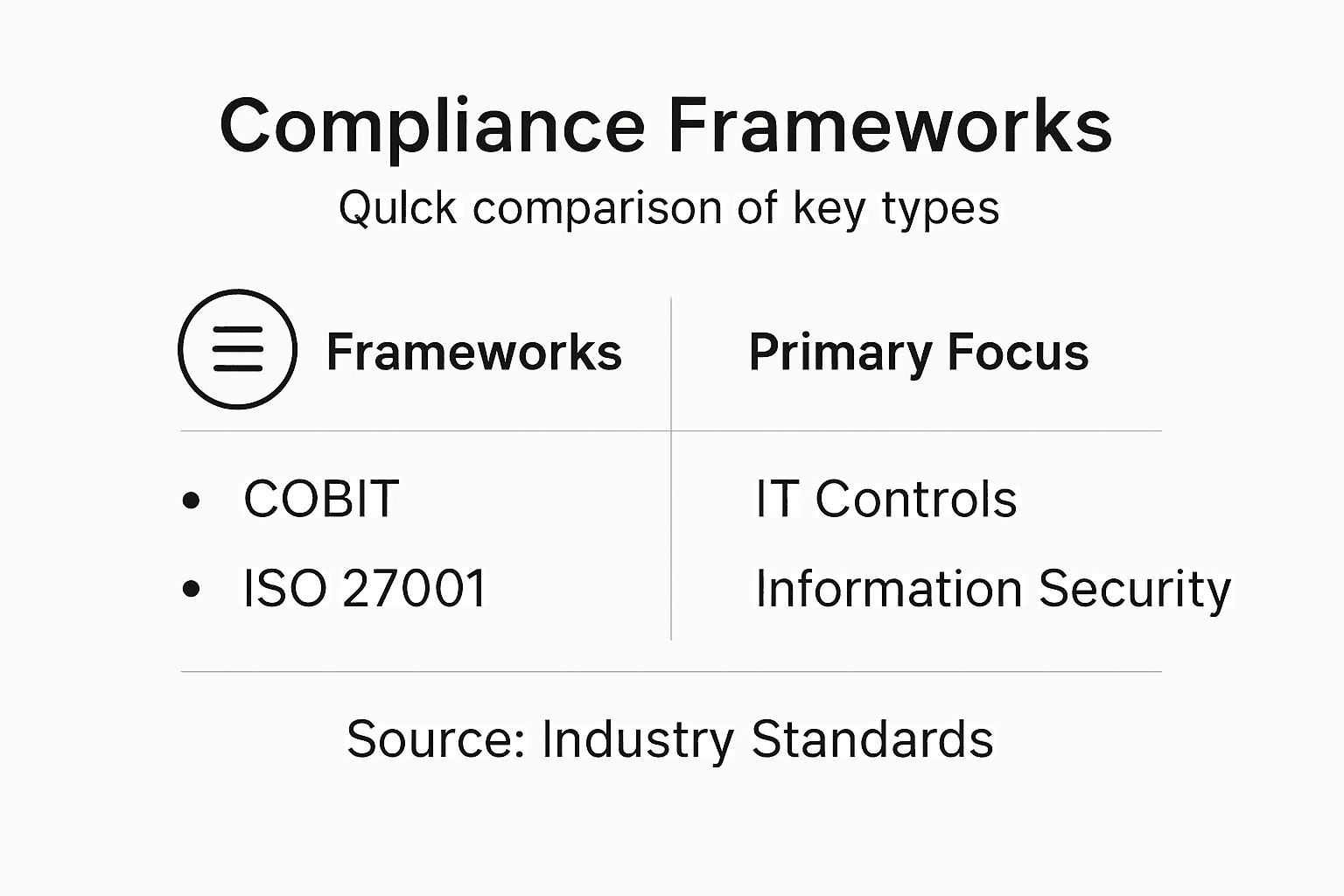
Organizations often implement multiple compliance frameworks simultaneously, recognizing that no single standard comprehensively addresses all regulatory requirements. This strategic approach allows businesses to streamline compliance efforts, reduce redundancies, and create more flexible risk management systems. By mapping controls across different frameworks, companies can develop more robust and adaptable compliance strategies that align with their specific operational contexts and risk profiles.
Here’s an at-a-glance comparison of major compliance frameworks and their main focuses:
Framework | Primary Focus | Key Industries | Unique Feature |
COBIT | IT governance & control | Technology, Finance | Emphasis on business alignment |
NIST SP 800 | Cybersecurity standards | Government, Private | Detailed threat mitigation guidance |
HITRUST | Integrated regulatory standards | Healthcare, Insurance | Combines multiple frameworks into one |
ISO 27001 | Information security management | All sectors | Internationally recognized certification |
PCI DSS | Payment data protection | Retail, Banking | Mandated for credit card transactions |
Pro Tip: Develop a cross-framework mapping strategy to identify overlapping controls and eliminate unnecessary compliance redundancies.
Global Standards and Regional Regulatory Drivers
Global regulatory compliance represents a complex landscape of interconnected standards and regional requirements that challenge organizations worldwide. Regulatory compliance strategies must navigate significant variations in regulatory design, enforcement capabilities, and administrative frameworks across different jurisdictions.
Developing countries and emerging markets face unique challenges in implementing robust compliance systems. These regions often contend with large informal economic sectors, limited regulatory infrastructure, and complex administrative barriers. Effective regulatory delivery requires a nuanced approach that balances prescriptive requirements with practical implementation strategies, recognizing the diverse economic and social contexts of different regions.
Global regulatory frameworks are increasingly shifting towards more human-oriented, evidence-based approaches. This evolution emphasizes outcome-focused regulation rather than purely punitive measures, promoting compliance through clear objectives and flexible implementation methods. Modern regulatory strategies prioritize risk-based monitoring, data-driven insights, and adaptive governance models that can respond quickly to technological and societal changes.
Pro Tip: Develop a flexible compliance strategy that can adapt to regional variations while maintaining core global standards and principles.
Roles and Responsibilities in Framework Implementation
Compliance framework implementation requires a strategic allocation of roles and responsibilities across multiple organizational levels. Compliance roles span from individual employees to top leadership, creating a comprehensive ecosystem of accountability and oversight. Each organizational tier plays a critical part in maintaining regulatory adherence and operational integrity.
Key actors in the compliance framework include dedicated compliance officers, specialized committees, and executive leadership. Compliance officers are responsible for developing policies, conducting training programs, monitoring adherence, and establishing communication channels for reporting potential violations. Compliance committees provide governance support, ensuring that policies are consistently applied and aligned with organizational objectives. Board members and audit committees maintain critical oversight, guaranteeing that compliance strategies remain robust and responsive to changing regulatory landscapes.
Successful compliance programs require clear reporting structures and transparent communication mechanisms. This involves creating well-defined escalation pathways, implementing consistent enforcement standards, and fostering a culture of accountability. Organizations must develop role-specific training, establish clear performance expectations, and create systems that enable prompt response to potential compliance issues while protecting individuals who raise legitimate concerns.
Pro Tip: Create a comprehensive compliance role matrix that clearly defines responsibilities, reporting lines, and accountability for each organizational level.
Navigating Costs, Risks, and Common Pitfalls
Compliance framework implementation involves sophisticated financial and operational considerations that extend far beyond simple checklist completion. Compliance risk management requires organizations to carefully balance investment costs against potential regulatory vulnerabilities, recognizing that ineffective approaches can lead to substantial financial and reputational damages.
The financial burden of regulatory compliance can be significant, with companies typically spending between 1.3% to 3.3% of their total wage bill on compliance-related activities. Regulatory compliance costs vary dramatically across industries and company sizes, with mid-sized organizations often experiencing the most challenging per-employee expense structures. These costs encompass multiple dimensions including training programs, audit preparations, policy development, monitoring systems, and potential enforcement mechanisms.
Common pitfalls in compliance framework management include inadequate risk assessment, poor communication channels, insufficient leadership support, and failure to adapt to evolving regulatory landscapes. Organizations must develop data-driven improvement strategies that continuously evaluate the effectiveness of compliance investments, ensuring that expenditures directly correlate with meaningful risk mitigation. This requires creating flexible frameworks that can rapidly respond to changing regulatory requirements while maintaining cost-effectiveness and operational efficiency.
The table below summarizes common compliance pitfalls and practical ways organizations can overcome them:
Common Pitfall | Potential Impact | Recommended Solution |
Inadequate risk assessment | Missed vulnerabilities | Implement ongoing risk evaluations |
Poor communication | Confusion or noncompliance | Establish clear reporting lines |
Insufficient leadership support | Lack of accountability | Engage executives in oversight roles |
Failure to adapt | Regulatory penalties | Review and update compliance regularly |
Pro Tip: Conduct an annual comprehensive review of your compliance expenditures, mapping specific investments directly to measurable risk reduction outcomes.
Strengthen Your Compliance Framework for Lasting Control and Confidence
Building and maintaining an effective compliance framework is essential for organizations facing evolving regulatory demands and complex risk landscapes. This article highlights common challenges such as risk assessment gaps, fragmented communication, and leadership accountability that can undermine your compliance efforts. Marensa Advisory FZ-LLC understands these pain points and offers tailored solutions designed to embed strong controls and proactive governance throughout your operations. Whether you need support developing clear policies, delivering targeted training, or implementing robust monitoring systems Marensa’s expertise in governance, risk, and compliance advisory ensures your framework adapts dynamically and remains resilient.
Take control of your regulatory journey now by partnering with a consulting firm that prioritizes practical implementation aligned with your business realities. Discover how Marensa Advisory can help you build a compliance framework that withstands scrutiny and drives meaningful risk reduction. Learn more about our comprehensive services including AML/CFT frameworks, licensing support, and outsourced compliance roles at Marensa Advisory and explore how we can tailor solutions for your financial or non-financial enterprise. Visit our main website today and start transforming your compliance challenges into sustainable strengths.
Frequently Asked Questions
What is a compliance framework?
A compliance framework is a structured approach that organizations use to manage regulatory requirements, ethical standards, and operational controls. It integrates various disciplines to embed legal adherence into the organizational culture.
What are the key components of an effective compliance framework?
An effective compliance framework typically includes written policies, leadership oversight, robust communication channels, comprehensive training programs, and systematic monitoring mechanisms to ensure compliance and mitigate risks.
How do different compliance frameworks compare?
Different compliance frameworks, like COBIT, NIST SP 800, HITRUST, and ISO 27001, serve unique purposes and focus on varying areas such as IT governance, cybersecurity, and information security management. Organizations often implement multiple frameworks to address all their compliance needs more effectively.
What are common pitfalls in managing compliance frameworks?
Common pitfalls in compliance management include inadequate risk assessments, poor communication, insufficient leadership support, and a failure to adapt to evolving regulations. Organizations can overcome these by implementing ongoing evaluations and fostering a culture of accountability.
Recommended


Comments