


Master Canada MSB regulations: 52% face penalties in 2026
- Marensa Advisory

- Mar 7
- 11 min read

Many financial institutions mistakenly believe that obtaining an MSB license marks the end of their compliance journey. In reality, Canadian MSBs must register with FINTRAC and navigate a complex dual oversight framework that combines AML/CTF obligations with operational governance mandates under the Retail Payment Activities Act. This guide delivers clarity on licensing, ongoing compliance requirements, virtual asset rules, and practical strategies to meet 2026 regulatory expectations without compromise.
Key takeaways
Point | Details |
FINTRAC compliance is mandatory | All MSBs must implement AML/CTF programs including suspicious transaction reporting and five-year record retention. |
Dual oversight framework | RPAA introduces Bank of Canada supervision alongside FINTRAC, expanding governance and prudential requirements. |
VASPs face heightened scrutiny | Virtual asset service providers must comply with enhanced AML controls and RPAA prudential standards. |
Enforcement is intensifying | Recent amendments increase penalties and operational compliance costs for non-compliant MSBs. |
Overview of MSB regulatory framework in Canada
Canada’s MSB regulatory environment operates through a multi-layered framework designed to prevent financial crime while ensuring operational integrity. FINTRAC serves as the primary AML/CTF regulator under the Proceeds of Crime (Money Laundering) and Terrorist Financing Act (PCMLTFA), establishing baseline compliance standards for all money services businesses. The Bank of Canada has assumed an emerging role through the Retail Payment Activities Act, adding prudential oversight to the regulatory mix.
MSBs in Canada include businesses engaged in currency exchange, remittance services, issuing or redeeming money orders, and dealing in virtual currencies. Registration triggers apply when you offer these services, particularly if you maintain a physical presence in Canada or serve Canadian customers from abroad. The definition extends beyond traditional financial services to encompass cryptocurrency exchanges, NFT marketplaces, and payment processors.
Key regulatory obligations include:
Implementing suspicious transaction reporting mechanisms to detect potential money laundering
Conducting customer due diligence aligned with risk-based KYC protocols
Maintaining comprehensive records for a minimum five-year period
Reporting large cash transactions exceeding prescribed thresholds
Establishing governance frameworks that demonstrate operational control
FINTRAC’s enforcement authority extends to all registered MSBs, regardless of business model or technology platform. You must implement controls that withstand regulatory examination, not merely check compliance boxes. The regulatory framework demands continuous adaptation as your business evolves and new payment methods emerge.
For comprehensive guidance on navigating FINTRAC regulatory guidance, compliance officers should prioritize understanding both the letter and spirit of regulatory expectations. This foundation enables effective risk management and positions your institution to respond proactively to regulatory developments.
MSB registration and licensing process in Canada
Securing MSB registration requires methodical preparation and submission of detailed documentation to FINTRAC. The application processing averages 4 to 5 months (used to be 2-3 months before), though incomplete submissions can extend timelines significantly. Your first step involves confirming registration necessity based on services offered and your operational footprint.
Follow this structured approach:
Verify that your business activities fall within MSB definitions under Canadian law
Establish Canadian incorporation or partnership registration as required
Develop comprehensive AML/CTF program documentation including policies, procedures, and risk assessments
Prepare KYC protocols with enhanced due diligence measures for high-risk customers
Document your compliance governance structure including designated compliance officer roles
Submit your application through FINTRAC’s online portal with all supporting materials
Respond promptly to any information requests during the review period
Physical presence requirements deserve particular attention. MSBs must demonstrate substantive operations in Canada, not merely a registered address. This includes maintaining offices, employing staff, and conducting genuine business activities within Canadian jurisdiction. Virtual-only operations face additional scrutiny regarding their Canadian nexus.
Your AML/CTF program documentation must reflect genuine operational integration, not template policies. FINTRAC reviewers assess whether your controls align with your actual business model, customer base, and risk profile. Generic compliance manuals signal superficial preparation and invite deeper regulatory questioning.
Pro Tip: Submit your application only after completing internal policy implementation and staff training. FINTRAC may request evidence of operational compliance during the review process, and demonstrating active controls strengthens your application credibility.
Documentation requirements extend beyond initial registration. You must maintain current information with FINTRAC, updating any material changes to your business structure, services offered, or compliance framework within prescribed timeframes. For detailed support navigating the Canada MSB licensing process, consider engaging specialists who understand regulatory nuances and common application pitfalls.
AML/CTF compliance requirements for Canadian MSBs
Ongoing AML/CTF compliance forms the operational backbone of MSB regulation in Canada. Your obligations extend far beyond initial registration, requiring continuous monitoring, reporting, and program enhancement. Canadian MSBs must implement enhanced due diligence for politically exposed persons and maintain meticulous transaction records aligned with risk-based frameworks.
Core compliance obligations include:
Submitting suspicious transaction reports when reasonable grounds exist to suspect money laundering or terrorist financing
Filing large cash transaction reports for transactions exceeding $10,000 CAD
Conducting ongoing customer due diligence with periodic reviews based on risk assessment
Implementing transaction monitoring systems capable of detecting unusual patterns
Maintaining five-year records covering customer identification, transactions, and compliance activities
Appointing a designated compliance officer with authority and resources to fulfill regulatory obligations
Risk assessment drives effective AML/CTF programs. You must evaluate customer risk based on factors including geographic location, transaction patterns, business relationships, and product usage. High-risk customers require enhanced due diligence measures such as source of funds verification, beneficial ownership identification, and senior management approval for account establishment.

Transaction monitoring systems must align with your risk profile and business complexity. Smaller MSBs may implement manual review processes with clear documentation protocols, while larger operations require automated systems capable of analyzing transaction patterns in real time. Your monitoring approach should detect both individual suspicious transactions and patterns suggesting structured activity designed to evade reporting thresholds.
Pro Tip: Document your risk assessment methodology and monitoring criteria explicitly. During examinations, regulators assess whether your controls match your stated risk tolerance and business model, not whether you use sophisticated technology.
Employee training ensures consistent compliance execution across your organization. All staff handling customer interactions, transaction processing, or compliance functions require regular training on AML/CTF obligations, red flags, and reporting procedures. Training must be documented, tested, and updated to reflect regulatory changes and emerging threats.
For institutions seeking to strengthen their AML/CTF compliance frameworks, focus on building programs that demonstrate genuine risk management rather than formulaic policy adherence. Recent FINTRAC enforcement trends reveal increasing scrutiny of program effectiveness and operational implementation.
Impact of the Retail Payment Activities Act on MSBs
The Retail Payment Activities Act fundamentally reshapes Canada’s MSB regulatory landscape by introducing dual oversight and expanded operational requirements. RPAA imposes dual oversight by FINTRAC and the Bank of Canada, adding prudential supervision and operational governance mandates since 2023. This framework extends beyond AML/CTF compliance to encompass safety, soundness, and consumer protection objectives.
Key RPAA impacts include:
Dual registration requirements with both FINTRAC and the Bank of Canada for certain MSB activities
Expanded MSB definitions capturing previously unregulated payment service providers
Prudential standards addressing capital adequacy, liquidity management, and operational resilience
Enhanced governance requirements including board oversight and risk management frameworks
Ongoing reporting obligations covering operational metrics and financial condition
The RPAA framework applies differently based on your business model and transaction volumes. Payment service providers exceeding specified thresholds face comprehensive prudential regulation, while smaller operators may qualify for streamlined requirements. Understanding which regulatory tier applies to your operations determines your compliance burden and timeline.
Regulatory Aspect | FINTRAC Oversight | Bank of Canada (RPAA) |
Primary Focus | AML/CTF compliance | Prudential safety and soundness |
Key Requirements | Transaction reporting, KYC, record retention | Capital adequacy, operational resilience |
Registration Scope | All MSBs offering prescribed services | Payment service providers above thresholds |
Enforcement Authority | Penalties for AML violations | Operational restrictions, license revocation |
Prudential requirements under RPAA demand financial and operational infrastructure beyond traditional MSB compliance. You must demonstrate adequate capital to absorb potential losses, maintain liquidity sufficient to meet payment obligations, and implement business continuity plans addressing operational disruptions. These standards reflect lessons from payment system failures and aim to protect consumers from service interruptions.
Governance obligations require board-level oversight of compliance and risk management functions. Your board must understand MSB-specific risks, approve key policies, and receive regular reporting on compliance status and emerging threats. This represents a significant shift from operational compliance managed solely by staff-level personnel.
Navigating regulatory challenges for MSBs requires coordinating compliance across both FINTRAC and Bank of Canada expectations. Institutions must integrate AML/CTF controls with prudential risk management, creating unified frameworks that satisfy both regulators without duplicative processes.
Regulatory obligations for virtual asset service providers (VASPs) under MSB regulations
Virtual asset service providers face particularly stringent oversight within Canada’s MSB framework. VASPs must comply with both AML/CTF requirements and RPAA, facing enhanced scrutiny for cryptocurrency exchanges, NFT marketplaces, and custodial services. The regulatory approach reflects heightened risks associated with digital assets including anonymity, cross-border transfers, and rapid technological evolution.
VASP-specific obligations include:
Registration with FINTRAC as MSBs offering virtual currency services
Implementation of AML/CTF programs tailored to virtual asset transaction risks
Enhanced customer due diligence addressing anonymity and pseudonymity concerns
Transaction monitoring systems capable of analyzing blockchain activity and identifying suspicious patterns
Compliance with travel rule requirements for virtual asset transfers between service providers
RPAA prudential standards addressing custody, cybersecurity, and operational resilience
Your AML/CTF program must address unique virtual asset risks that differ from traditional financial services. Customer verification becomes more complex when dealing with self-custody wallets, decentralized exchanges, and privacy coins. You need controls that establish genuine customer identity despite technological features designed to enhance anonymity.
Transaction monitoring for virtual assets requires specialized capabilities beyond traditional banking systems. You must analyze on-chain activity, identify high-risk counterparties, and detect patterns suggesting money laundering or sanctions evasion. Many VASPs implement blockchain analytics tools to augment manual review processes and identify connections to illicit activity.
Prudential compliance under RPAA addresses operational risks inherent in virtual asset custody and transaction processing. You must implement robust cybersecurity controls protecting private keys and customer assets, maintain segregated customer funds, and establish business continuity plans addressing exchange outages or security breaches. These requirements reflect regulatory concern about consumer protection and market integrity.
Risk management for VASPs extends to market volatility, technological vulnerabilities, and fraud schemes targeting digital assets. Your governance framework should address these risks through appropriate limits, monitoring systems, and incident response protocols. For guidance on VASP compliance in Canada MSB context, focus on building controls that address both regulatory expectations and genuine operational risks.
Recent amendments and trends in Canadian MSB regulation
Canada’s MSB regulatory landscape continues evolving through legislative amendments and enforcement developments. New amendments require updated document retention timelines and clarified registration document validity, while enforcement actions reveal increasingly stringent regulatory expectations. Understanding these trends enables proactive compliance adaptation rather than reactive crisis management.
Key regulatory developments include:
Extension of record retention obligations to five years for all compliance documentation
Clarified requirements for incorporation document age and validity in registration applications
Increased FINTRAC enforcement actions targeting inadequate AML/CTF program implementation
Rising administrative monetary penalties for reporting failures and compliance deficiencies
Bank of Canada guidance on RPAA implementation timelines and prudential standards
Enforcement intensity has increased significantly, with regulators pursuing penalties for violations previously addressed through warning letters or compliance orders. FINTRAC’s enforcement approach emphasizes substantive compliance over technical adherence, examining whether your controls actually manage risk rather than merely existing on paper. This shift demands genuine operational integration of compliance functions.
Operational compliance costs continue rising as regulatory expectations expand. MSBs must invest in technology systems, compliance personnel, and external expertise to meet evolving standards. Smaller operators face particular pressure as compliance costs consume larger percentages of revenue, potentially forcing market consolidation or exit.
Technology adoption shapes modern MSB compliance, with regulators expecting automated monitoring, data analytics, and real-time reporting capabilities. Manual processes remain acceptable for smaller operations, but you must demonstrate controls appropriate to your risk profile and transaction volumes. Advanced technology alone doesn’t satisfy compliance obligations without proper governance and oversight.
Market participants are shifting toward proactive compliance cultures emphasizing continuous improvement over minimum standards. Leading MSBs implement ongoing risk assessments, regular policy updates, and comprehensive staff training programs. This approach reduces enforcement risk while positioning institutions to adapt quickly to regulatory changes. For insights on 2026 compliance trends, focus on building evidence of genuine implementation rather than policy documentation.
Penalties, risks, and best practices for MSB compliance
Regulatory non-compliance carries severe consequences ranging from financial penalties to license revocation and criminal prosecution. Understanding enforcement triggers and implementing robust controls protects your institution from regulatory action while strengthening operational integrity. Common violations include failure to report suspicious transactions timely, inadequate customer due diligence, and maintaining insufficient compliance documentation.
Enforcement consequences include:
Administrative monetary penalties reaching hundreds of thousands of dollars for serious violations
Compliance orders requiring remedial action and enhanced reporting to regulators
License suspension or revocation for persistent non-compliance or egregious violations
Criminal prosecution for willful violations enabling money laundering or terrorist financing
Reputational damage affecting customer relationships and business partnerships
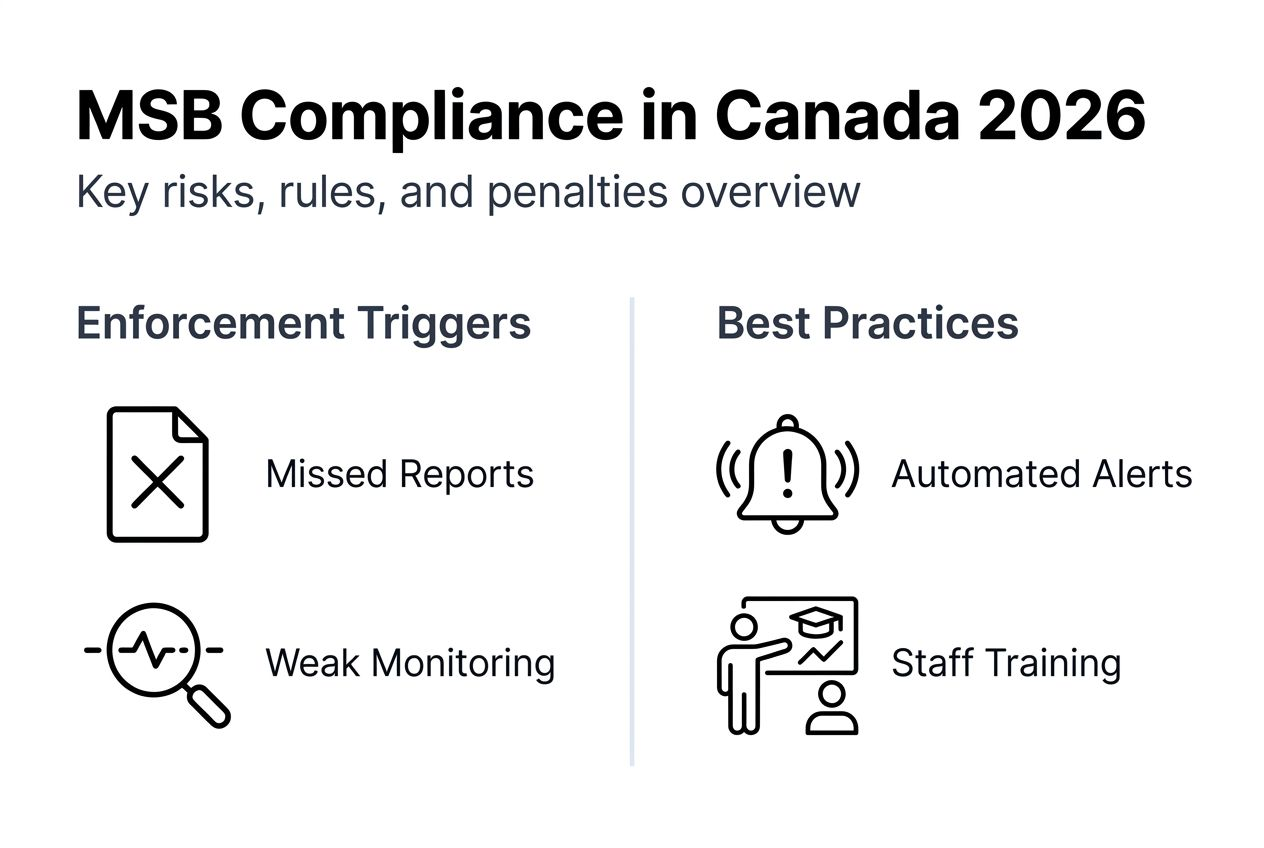
Frequent enforcement triggers reveal common compliance weaknesses. Inadequate transaction monitoring systems that fail to detect obvious suspicious activity invite regulatory scrutiny. Delayed or missing suspicious transaction reports demonstrate compliance program failures. Incomplete customer identification records signal superficial KYC implementation rather than genuine due diligence.
Best practices for sustainable compliance include automated transaction monitoring systems appropriate to your business scale, continuous employee training covering regulatory updates and emerging threats, and strong governance frameworks with clear accountability. Your compliance officer requires sufficient authority, resources, and access to senior management to fulfill regulatory obligations effectively.
Regular internal audits identify compliance gaps before regulators discover them during examinations. You should conduct periodic testing of transaction monitoring systems, review customer due diligence files for completeness, and assess whether policies reflect actual operational practices. Self-identified issues can be remediated proactively, demonstrating good faith compliance efforts.
Adapting to evolving regulations requires monitoring regulatory developments, participating in industry forums, and maintaining relationships with compliance professionals. The MSB regulatory landscape will continue changing as payment technologies evolve and enforcement priorities shift. Institutions that build flexible compliance frameworks can adjust quickly to new requirements.
For support in addressing common MSB compliance risks, consider implementing compliance checklists that provide systematic approaches to regulatory adherence. Drawing insights from banking compliance best practices can strengthen your MSB compliance infrastructure.
Explore Marensa Advisory’s regulatory compliance solutions
Navigating Canada’s complex MSB regulatory framework demands specialized expertise and practical implementation support. Marensa Advisory delivers comprehensive regulatory and compliance services tailored to financial institutions seeking effective governance frameworks and sustainable compliance programs. Our team brings deep experience in MSB licensing, AML/CTF implementation, and regulatory readiness across North American jurisdictions.
We support clients through every stage of the compliance journey, from initial registration strategy to ongoing program enhancement. Our financial licensing support helps institutions secure approvals efficiently while building foundations for long-term regulatory success. We emphasize practical solutions aligned with your operational reality, not generic templates that fail regulatory scrutiny.
Our risk management solutions integrate compliance obligations with broader governance objectives, creating unified frameworks that satisfy regulators while supporting business objectives. Whether you need MLRO support, compliance officer outsourcing, or comprehensive program development, we deliver expertise that withstands regulatory examination and positions your institution for sustainable growth.
Frequently asked questions about Canada MSB regulations
What is the typical timeline for MSB license approval in Canada?
MSB license approval usually takes 4 to 5 months after submitting a complete application to FINTRAC. Delays occur when documentation is incomplete, AML/CTF programs lack operational detail, or additional information requests require time to fulfill. Prepare thoroughly before submission to avoid extended timelines.
How does the Retail Payment Activities Act affect MSB compliance?
RPAA adds Bank of Canada oversight alongside FINTRAC, introducing prudential licensing and operational controls for MSBs. It expands regulatory scope to include payment service providers previously outside MSB definitions. Dual oversight requires coordinating compliance across both AML/CTF and prudential requirements.
What specific AML obligations do virtual asset service providers face?
VASPs must implement tailored AML programs addressing virtual currency transaction risks, report virtual asset transfers, and comply with RPAA prudential rules. They face heightened scrutiny due to anonymity features, cross-border transaction ease, and technological complexity. Enhanced customer due diligence and blockchain monitoring are essential.
What are common reasons MSBs face penalties or enforcement?
Typical enforcement causes include failure to report suspicious transactions timely, incomplete record keeping, and weak compliance programs lacking operational integration. Inadequate customer due diligence and delayed responses to regulatory inquiries also trigger enforcement. Continuous training and real-time monitoring help prevent violations.
Recommended


Comments